
 Jen Frank
I am blessed to work with a remarkable number of high-performing clients. These clients get great annual performance reviews. They are often delivering a huge amount of excellent work. They are helpful teammates and caring bosses. And many of them are exhausted, because they’ve tipped into over-performing.
What does over-performing look like from the outside? Working long hours, neglecting their health and/or family, and doing everything that’s asked of them – even as the number of those requests increase.
What’s a high-performer to do to correct over-performing before it becomes burnout? In coaching we often have conversations about:
Prioritization and managing time/energy
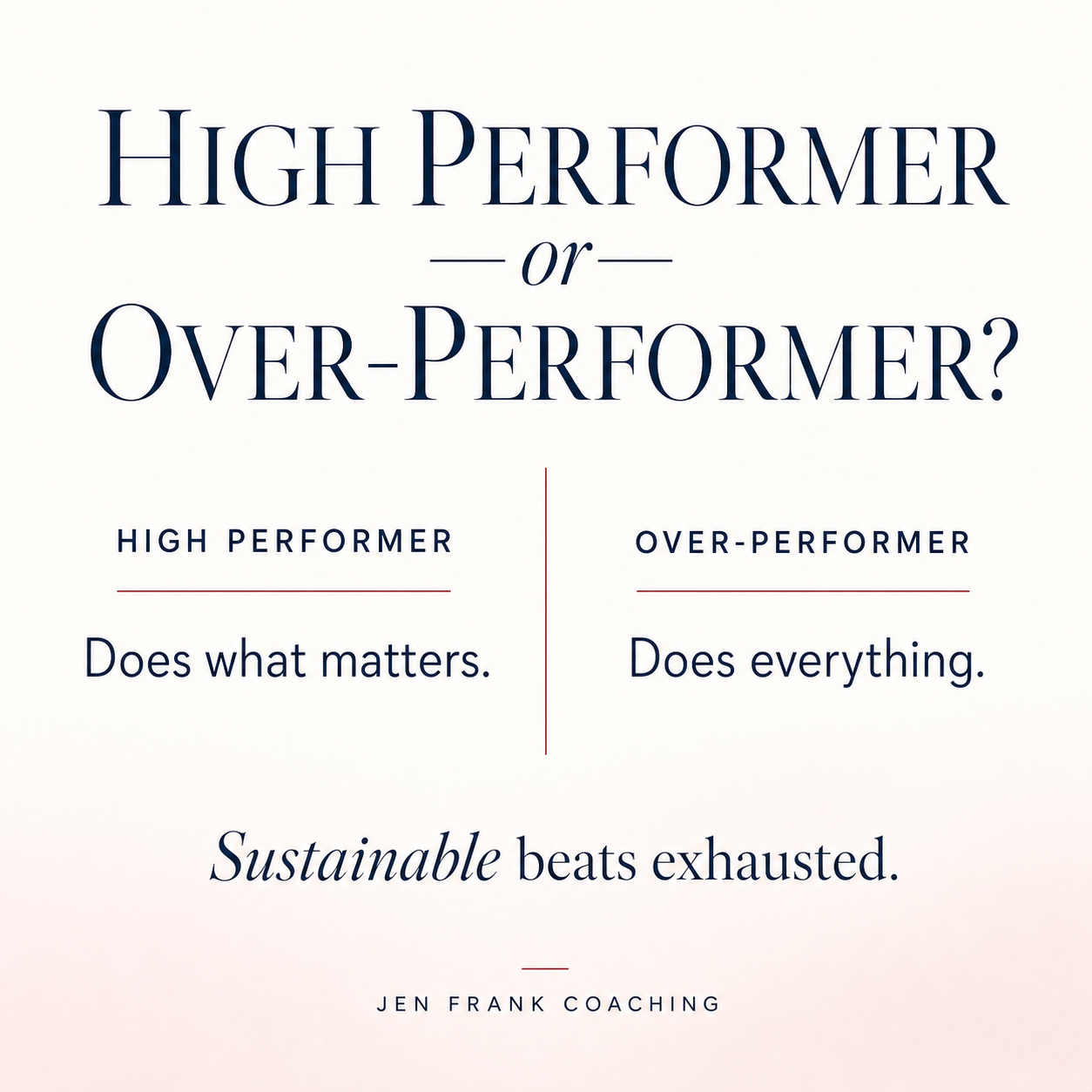
Everything is not equally important. Your highest priorities get your best effort. Medium priorities get “good enough” effort. Low priorities…well, do we even need to do those?
If you’re a perfectionist, it’s going to be hard to just do “enough” for those medium priorities. Try giving 10% less on one that’s low stakes and see what happens. ( I bet no one notices.)
Not sure what’s a priority? Sometimes asking the boss to help prioritize can be useful, but bosses often say it’s all important! You can also try using the Covey matrix to sort out important vs urgent tasks.
How to handle too much work (i.e., the volume issue)
In this case the client knows how to do what is being asked of them, but there is just too much of it. If there is a volume-of-work issue, you have two choices:
1. Say no
Saying no doesn’t mean when your boss gives you another assignment that you just say “no” and walk away. It could be an opportunity for a conversation about priorities with your boss. Or you may be able to negotiate the deadlines or what part of the work you can handle – and what part someone else can cover. And if you don’t need to give a yes or no on the spot, you may stall; this gives you time to think and come up with a really nice no.
2. Ask for help
You may need to ask others for help or delegate in order to handle the volume of work coming your way. For example, if people are sending you AI workslop, maybe you push it back to them for clean-up instead of doing it yourself. Or maybe there is an opportunity for someone more junior to be trained in a task you usually do.
Self-Care
When isn’t self-care the answer?! You may not be able to pack a bag and go find a beach, but you might be able to take a walk – or a nap. We all reach that point when our energy and brainpower are too low to be productive. Take a break and come back at it later. The work will always be there and it will feel so important, but your health is even more important. It’s up to you to know and set your limits.
Where are you over-performing? Where can you make some healthy adjustments so you can be your high-performing self in a sustainable way?
Go, self-care!
p.s. I’d love to hear what you do to avoid over-performing! Please comment on this blog at https://www.linkedin.com/in/jenfrankcoaching/